
Deliverability · 2026-08-28 · 8 min read · By Arden Talbot, founder of SheetLink
Autoresponders that do not feel automated
The confirmation email after a form submission is the most-read message you will ever send, and usually the least considered. Here is what a good one does.
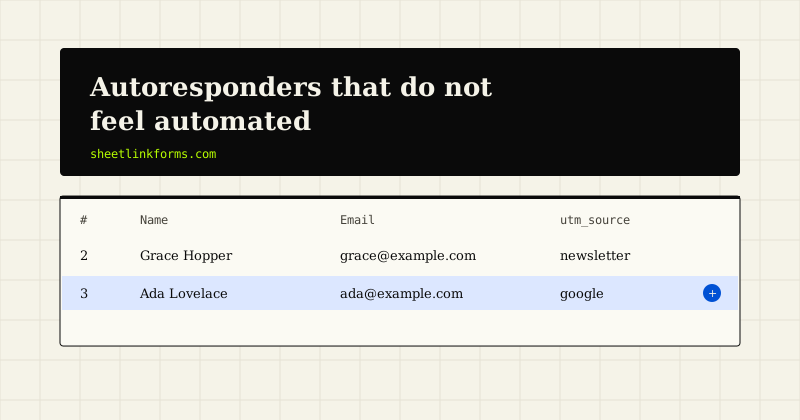
The most-read message you send
Open rates for confirmation emails are far higher than for anything you will ever send deliberately, because the recipient is expecting it and just took an action to cause it. The person is at maximum attention.
Most businesses spend that attention on a paragraph of template text nobody wrote on purpose. Thank you for contacting us. We have received your enquiry. A member of our team will be in touch shortly. This is a no-reply address.
Every one of those sentences is doing less than it could, and the last one is doing active harm.
What the reader actually wants to know
Three things, in this order. Did it arrive. What happens next. What to do if nothing does.
The first is the whole reason the message exists, and it is why a confirmation should repeat something specific back: the subject they chose, the date they requested, the model number they asked about. Generic acknowledgement proves a system fired. Repeating their own words back proves their content arrived.
The second sets expectations, and the trick is to be concrete enough to be useful and honest enough to be true. Within one working day is a commitment. Shortly is not, and readers have learned it means nothing.
The third question is the one almost every confirmation ignores, and it is the one that decides whether a delayed reply becomes a complaint. Tell them what to do if the timeframe passes: a phone number, a second address, or simply an instruction to reply to this message. A person who knows they have a route will wait. A person who does not will assume they have been forgotten and either give up or escalate, and both outcomes are worse than the sentence it would have taken to prevent them.
Never send from no-reply
A no-reply address takes the one moment a person is most likely to add something helpful and slams a door on it. They will reply anyway, because that is what people do with email, and the reply will vanish.
The alternative costs nothing. Send from a monitored address, or from your own domain with Reply-To pointing somewhere real. A reply to a confirmation is frequently the most valuable message in the thread, because it is where people attach the file they forgot or correct the phone number they mistyped.
If the volume genuinely cannot be monitored, say so plainly and give an alternative route in the same sentence. That is honest. A no-reply address is not.
Short beats thorough
A confirmation is not the place for your company story, your social links, your newsletter pitch and a banner. The reader has one question and will scan for the answer.
Four or five lines is enough. Confirmation with a specific detail. What happens next, with a real timeframe. How to reach you if it does not. A plain sign-off.
The temptation to add a promotional block is strong precisely because the open rate is high. Resist it. This message is doing reassurance work, and mixing in a pitch converts a service message into a marketing one, which changes both the reader's reaction and, for subscribed content, the rules that apply to it.
The delivery irony
There is a cruel joke built into confirmation emails. The message whose only job is to say we received your message is itself an email, subject to every delivery failure that afflicts the notification going the other way.
A confirmation that lands in spam is worse than none at all. The visitor concludes you ignore people, and they have no way to know a message exists in a folder they never open.
So the confirmation deserves the same authentication care as everything else: your own domain in From, valid signing, and a body that does not look like bulk mail. Plain text or very light HTML performs better here than a designed template, and it also renders correctly everywhere.
Confirm on the page first
The most reliable confirmation is the one that does not travel. The response the browser gets is immediate, cannot be filtered, and is seen by every single submitter.
A good thank-you page does most of the reassurance work by itself: it repeats what was submitted, states what happens next, and gives an alternative contact route. The email then becomes a durable copy rather than the only confirmation, which is a much less fragile arrangement.
If you only invest in one of the two, invest in the page. It reaches everybody.
What to include, concretely
- A specific detail from their submission, so it is clearly not generic.
- A real timeframe for the reply.
- A working reply route, and a second route such as a phone number.
- A reference they can quote, if you use one.
- Anything they need to prepare before your reply arrives.
The fifth item is underrated. If your first reply always asks for the same three pieces of information, ask for them in the confirmation and halve the round trips.
What to leave out is a shorter list but worth stating. No social links, because nobody waiting for a quote wants to follow you on anything. No newsletter signup, because they did not ask and it turns a service message into a pitch. No legal boilerplate longer than the message itself. And no restatement of every hidden field you captured, which looks like a debug dump and draws attention to data collection the visitor had not thought about.
Timing and the double message
Send it immediately. A confirmation arriving twenty minutes later has missed the moment of doubt it exists to resolve, and by then the visitor has either forgotten or resubmitted.
Resubmission is worth designing for. When someone submits twice because they were unsure the first attempt worked, two confirmations arrive, which reads as sloppiness. Recognising a repeat submission from the same person within a short window and acknowledging it explicitly turns an embarrassment into a small display of competence.
It also stops your team working the same enquiry twice, which is the more expensive version of the same problem.
The version that ages well
Write the confirmation as if you were replying by hand and were in a hurry. That produces the right length, the right tone, and it is naturally free of the phrases that make automated mail feel automated.
Then make sure the record does not depend on it. When the submission is already a row in your spreadsheet with a timestamp and its source attached, the confirmation is a courtesy to the visitor rather than the only evidence the enquiry happened.
That separation is what lets you keep the message short. It is not carrying the weight of your pipeline; it is telling one person that a real thing happened and someone will get back to them.
A test worth running
Submit your own form from an address you rarely use, then read the confirmation on a phone without scrolling. If you cannot tell within two seconds that it arrived and when you will hear back, the message needs cutting.
Then check where it landed. If it went to spam, the delivery work matters more than the copy.
FAQ
Should every form send a confirmation?
Any form where the person is waiting for a human response, yes. For a newsletter signup the confirmation is often the double opt-in itself. For an internal form used by staff who can see the result, it is usually noise.
Plain text or HTML?
Light HTML or plain text. A heavily designed template looks like marketing, renders unpredictably, and gives filters more to dislike. The content of a confirmation is short enough that design adds little.
Is it worth including the full submission back to them?
A summary of the key fields, yes, and it doubles as a chance for them to spot their own typo. Echoing every field including hidden tracking values looks like a debug dump and can expose data the visitor did not realise you collected.
What if we genuinely cannot monitor replies?
Say that in one sentence and give a route that is monitored. Readers accept a stated constraint far better than a silent one, and a no-reply address with no alternative is the version that generates complaints.
Does the confirmation count as marketing?
Not while it stays a service message about the action they just took. Adding promotional content changes its character, which affects both how recipients react and which rules apply to sending it.
How do I stop duplicate confirmations?
Detect repeat submissions from the same person within a short window and acknowledge the repeat rather than sending a second identical message. It also prevents your team from working the same enquiry twice.
Should the thank-you page and the email say the same thing?
Consistent, not identical. The page should stand alone in case no email arrives. The email should stand alone in case the page was closed. Both need the timeframe and a contact route.
Who should the confirmation come from, a person or the company?
A named person outperforms a department for anything consultative, because replies to a name get written and replies to an inbox get skipped. The caveat is that the name must be reachable and must survive staff changes, so a shared address with a person's name in the display portion is usually the arrangement that lasts.
Confirm on the page, record in the sheet
SheetLink returns a real confirmation the moment a submission is accepted, and writes the row whether or not any email is sent.
Start freeSee the live demoWhat email bounces say about lead qualityWhat GDPR says about contact forms