
Spam defense · 2026-07-30 · 9 min read · By Arden Talbot, founder of SheetLink
Why silent spam filtering loses customers
A filter that deletes suspicious submissions has a failure mode you will never see: the real customer it guessed wrong about. That asymmetry should shape the whole design.
The failure you never see
A spam filter can fail in two directions, and only one of them shows up. When it misses spam, the junk lands in front of you and you delete it, mildly annoyed. When it wrongly flags a real message and the tool's policy is to discard flagged submissions, the failure is invisible by construction. No error, no log line you will ever read, no bounce back to the sender. A person tried to contact you, your software decided they were a robot, and the evidence was destroyed.
Most form tools' spam settings are described in terms of how much spam they catch. Almost none are described in terms of how many humans they catch, because that number is unmeasurable once the submissions are gone. This essay is about taking that asymmetry seriously.
Two errors with wildly different price tags
Call them by their names. A false negative - spam that gets through - costs you the seconds it takes to recognize and delete it. A false positive - a real submission that gets flagged - costs you the entire relationship that message would have started: the sale, the client, the hire, the bug report.
You do not need invented statistics to see the shape of the trade. If reviewing a flagged item costs seconds and a lost lead costs anywhere from real money to a reputation, then a filter would need to be implausibly close to perfect before deleting its suspicions became a good bet. No adversarial classifier is that close to perfect, and spam filtering is adversarial by definition - the senders adapt to whatever you deploy.
Filters guess for a living
Spam classification is probabilistic. Every signal that correlates with spam also occurs in legitimate traffic: real customers paste links to the page they are asking about, write from free email providers, submit from VPNs and hotel wifi, use browser autofill that completes a form in two seconds, and write terse messages like "call me about pricing" that carry almost no linguistic evidence of humanity.
The borderline cases are not an edge condition - they are exactly where interesting mail lives. The prospect in a hurry looks less human, statistically, than the leisurely bot built to look human. Any policy that turns a probability into a silent verdict is deciding these coin-flip cases invisibly, forever, with no appeal. Heuristics are useful evidence; they are terrible judges of last resort.
Silent drops destroy the feedback loop
There is a second cost beyond the lost leads themselves: you cannot tune what you cannot see. A filter that discards its positives gives you no way to audit its judgment, so its accuracy is unknowable and its configuration is guesswork. Was last month quiet because spam declined, or because the filter got hungrier? You have no data either way.
Feedback arrives, if at all, out of band and late: "I filled out your form twice and never heard back." Every operator who has received that message knows the cold feeling that follows - how many others did not bother to say so? A defense you cannot measure is not a defense you control. Visibility is not a nice-to-have on top of filtering; it is the thing that makes filtering safe to run at all.
Email learned this lesson twenty years ago
The email world settled this argument in the 2000s. Mail providers do not delete suspected spam; they put it in a folder. The spam folder is quarantine - a place where the filter's guesses remain visible, reversible, and countable. That design was forced by exactly the asymmetry described above: silently eating a real message is catastrophic in a way that showing a junk message never is.
The form-backend world, oddly, skipped the lesson. Plenty of form tools still treat "flagged" as "gone," reporting a spam count with no way to inspect the corpses. We think the email industry's judgment on this is correct and hard-won, and that form submissions - which skew commercial and high-intent - deserve at least the protection given to newsletters. That belief is core to how our pipeline is built.
What a review queue honestly costs
Quarantine is not free, and pretending otherwise would undercut the argument. A review queue costs attention: someone has to own it, glance at it on some cadence, and click approve on the occasional wrongly-held row. On a form drawing heavy spam, the queue can get long, and skimming fifty held submissions to rescue one real one is genuine work.
There is also a failure mode worth naming: a queue nobody ever opens degrades into a slower silent drop. The lead is technically recoverable, but if no one looks for ninety days, the recovery is theoretical and the customer is just as gone. Quarantine is a tool for teams willing to spend seconds per day on it; it is not absolution from paying attention.
What the queue buys you
In exchange, three things. First, a bounded worst case: the cost of a false positive collapses from "a lost customer" to "one click and a short delay." That is the whole game - the catastrophic outcome is designed out. Second, an audit trail: you can see what the filter flags and how often it is right, which turns tuning from folklore into observation.
Third, and least obvious: quarantine makes it safe to run filters stricter. When a false positive costs a click, you can afford aggressive heuristics that would be reckless in a delete-on-flag system. The strictness dial on each SheetLink form exists precisely because the downside of overflagging is small. Softer failure modes permit harder filtering - that inversion is the quiet payoff of the whole design.
Designing a queue people actually check
Since an unwatched queue is the residual risk, design against it. The queue should be visible where you already look - a count on the dashboard, not a buried settings page. Review should be one glance and one click, with the full submission in front of you. Approval should deliver the original row to its destination - late, but complete, in the same columns as everything else.
And the queue should be kept small by construction: hard-block only on near-certain signals so that quarantine holds genuine borderline cases rather than a firehose. In our stack, only the honeypot marks spam outright; rate limits bound the sheer volume that can arrive; everything in between is held for review. A short queue is a queue that gets read.
The counterargument, taken seriously
There are situations where review genuinely does not pay. If a form draws thousands of spam attempts a day and each lead is worth little, the arithmetic flips: review time can exceed lead value, and a gate at the front door - an invisible challenge like Turnstile - is the rational choice to shrink the flood before it becomes a queue. Likewise, a team that knows it will never check a queue should prefer defenses that fail loudly at submit time, where the user can at least retry.
These are real cases, and the honest answer is composition rather than dogma: challenge to cut volume where volume is the problem, quarantine to protect the borderline where judgment is the problem. We wrote up the full comparison in quarantine vs CAPTCHA.
Where we land
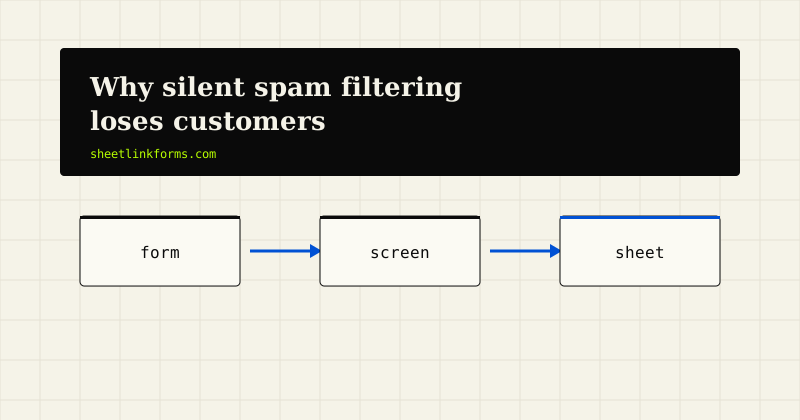
Our position, stated plainly: no submission should be silently destroyed on a guess. Signals short of certainty route to quarantine, where a false positive costs seconds; the one near-certain signal, the honeypot, is the only outright spam verdict in the system; and approval delivers the held row to your sheet exactly as if it had never been stopped.
The measure of a spam defense is not the volume it blocks - blocking everything is trivial. It is the worst thing it can do to a real customer on its worst day. For a silent filter, the worst case is a lead that vanished without a trace. For a quarantine, it is a short delay and one click. You can see the whole flow on the live demo, or read the security page for what happens after approval.
FAQ
What is a quarantine queue in a form backend?
A holding area for submissions the spam stack distrusts but cannot condemn with certainty. Held rows stay visible and reviewable; approving one delivers it to the destination as normal. See the quarantine glossary entry for the short version.
Doesn't reviewing spam waste more time than it saves?
At typical volumes, no. Skimming a held submission takes seconds, and hard blocks plus rate limits keep the queue short. The comparison is not "review time vs zero" - it is "review time vs the expected cost of silently losing the occasional real lead," and leads are usually worth more than seconds.
How do I find out whether my current form tool drops submissions silently?
Test it. Submit a message engineered to look spammy - several links, a disposable email address, terse text - and then check whether it appears anywhere: inbox, dashboard, spam view, logs. If it vanished without a record, that is your answer, and a real customer can vanish the same way.
What happens to a quarantined submission when I approve it?
It is delivered to your spreadsheet through the normal pipeline - same columns, same delivery log entry, just later than it would have arrived. A false positive costs the delay between submission and your review, and nothing else.
Why not just allowlist known-good senders instead?
Because the submissions that matter most come from strangers. New customers are by definition unknown, so an allowlist protects exactly the traffic that needs no protection. Allowlisting works for internal tools; for a public lead form it inverts the point of having one.
Isn't a CAPTCHA also a silent failure mode?
Structurally, yes. A human who fails or abandons a challenge bounces with no record - a false positive you never see, just enforced at the door instead of after it. That symmetry is exactly why we compare the two designs head-on in quarantine vs CAPTCHA.
What if my queue fills up with hundreds of items?
That signals a volume problem, and volume has its own layers: rate limits cap the flood, the strictness dial adjusts what gets held, and enabling Turnstile on the affected form cuts automated volume before it reaches the queue. Quarantine is for the borderline, not for absorbing an attack.
Does SheetLink Forms ever discard a submission without review?
Suspicious submissions are never silently dropped. The honeypot - the one near-certain bot signal - marks submissions as spam outright; everything else the stack distrusts is quarantined for one-click review. The behavior is documented in the docs.
A false positive should cost a click, not a customer
SheetLink Forms quarantines suspicious submissions for one-click review - nothing silently vanishes. Free to start.
Start freeSee the live demo